
Vegetables
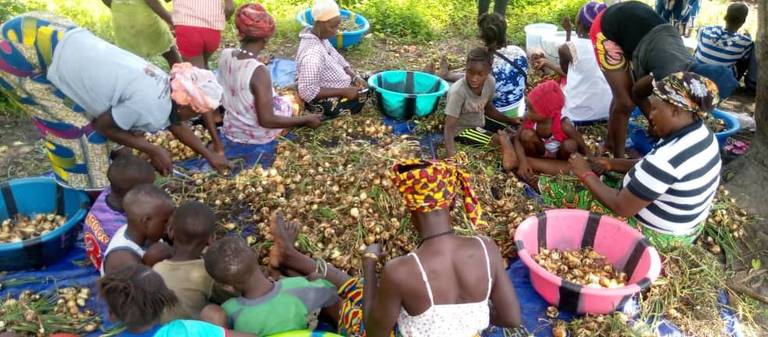
Onion, hot pepper and tomato growing gives farming households a cash crop alongside rice. AVDP supplies seed and tools and supports storage so produce keeps until it is sold.
What AVDP does
- Bulb onion, hot pepper and tomato seed for the growing season
- Onion curing machines to cut losses after harvest
- Greenhouse equipment and compost for vegetable model farms
How a solar borehole waters vegetables, and a village
AVDP is building solar-powered boreholes with irrigation so vegetable growers can farm through the dry season.
Step 1 of 6
Sunlight powers the pump
Solar panels turn sunlight into electricity for a pump at the bottom of the borehole. There is no fuel to buy and no generator to run.
Show as table
| Step | What happens |
|---|---|
| 1. Sunlight powers the pump | Solar panels turn sunlight into electricity for a pump at the bottom of the borehole. There is no fuel to buy and no generator to run. |
| 2. Water comes up from underground | The pump lifts groundwater up the borehole, even in the dry season when streams and hand-dug wells run low. |
| 3. A raised tank stores it | The water fills a tank on a tower. From there it flows out by gravity whenever it is needed, including after the sun goes down. |
| 4. Drip lines water the vegetables | Pipes carry the water to drip lines along each bed, which give every plant a little water at its roots and waste very little. |
| 5. Clean water for the community | In some communities the same borehole also has a tap, so families can collect water for drinking and cooking close to home. |
| 6. Vegetables through the dry season | With water all year, farmers keep growing tomato, pepper and onion after the rains end, and have more to eat and to sell. |
Onions that keep: curing and storage
Curing machines help onion growers keep their harvest for months and sell when prices are better.
Step 1 of 5
Harvesting the bulbs
AVDP supports more than 5,000 farmers growing onion, tomato and hot pepper in Port Loko, Koinadugu and Falaba. When the onion tops fall over, the bulbs are lifted.
Show as table
| Step | What happens |
|---|---|
| 1. Harvesting the bulbs | AVDP supports more than 5,000 farmers growing onion, tomato and hot pepper in Port Loko, Koinadugu and Falaba. When the onion tops fall over, the bulbs are lifted. |
| 2. Drying in the field | The bulbs are left in the field for a few days so the outer skins and necks begin to dry. |
| 3. Curing in the machine | Women's groups use curing and drying machines, with back-up generators, provided through AVDP. Properly cured onions keep much longer. |
| 4. Bagged and stored | Cured onions are bagged and stored, cutting the losses that come from having to sell, or watch spoil, the whole harvest at once. |
| 5. Sold when the price is right | Because the onions keep, groups can wait to sell until the market is short of onions and prices are better, so they earn more. |
Vegetables: from seed to market
What AVDP does at each step, from the seed a farmer plants to the buyer who pays for the harvest.
Seed
Bulb onion, hot pepper and tomato seed for the growing season.
Water
Boreholes with irrigation, so vegetables can be grown in the dry season.
Farming
Greenhouse equipment and compost for vegetable model farms.
After harvest
Onion curing machines so the harvest keeps longer before it is sold.
To market
Sold mostly in Freetown, Bo and Makeni, with some traders selling on to Guinea.
Show as table
| Step | What AVDP does |
|---|---|
| Seed | Bulb onion, hot pepper and tomato seed for the growing season. |
| Water | Boreholes with irrigation, so vegetables can be grown in the dry season. |
| Farming | Greenhouse equipment and compost for vegetable model farms. |
| After harvest | Onion curing machines so the harvest keeps longer before it is sold. |
| To market | Sold mostly in Freetown, Bo and Makeni, with some traders selling on to Guinea. |
The farming year in Sierra Leone
When each crop is planted and harvested. Months are typical; the rains, and so the work, can start earlier or later.
- Rice (main season)Upland and swamp rice. Early upland harvests can start at the end of August.
- Vegetables (dry season)Grown in inland valley swamps after the rice harvest. Water control lets some farmers harvest two or three times a year.
- Land preparation
- Planting
- In the field
- Harvest
Show as table
| Crop | Land preparation | Planting | In the field | Harvest | Note | Source |
|---|---|---|---|---|---|---|
| Rice (main season) | February to March | April to July | August | September to December | Upland and swamp rice. Early upland harvests can start at the end of August. | FAO GIEWS country briefs, 2021–2025; FEWS NET, 2016–2017 |
| Vegetables (dry season) | – | – | December to February | March to May | Grown in inland valley swamps after the rice harvest. Water control lets some farmers harvest two or three times a year. | FAO AQUASTAT; FEWS NET, February 2017; AVDP onion harvest, Kaffu Bullom, March 2024 |
Related news and notices
Related procurement
All procurement notices- Invitation for bidsSupply and Delivery of Vegetable SeedsDownload Word, (75 KB) for Supply and Delivery of Vegetable Seeds
- Invitation for bidsSupply and Installation of Onion Curing Machines and Cassava Processing Machines.Download Word for Supply and Installation of Onion Curing Machines and Cassava Processing Machines.